From July 23 to 25, the 9th National Advanced Seminar for Young and Middle-aged Core Teachers of Japanese Studies in Higher Education Institutions was held in Dalian. The event was co-hosted by the Japanese Sub-committee of the National Advisory Committee on Foreign Language and Literature Majors in Higher Education under the Ministry of Education, the Japanese Group of the College Foreign Language Teaching Guidance Committee under the Ministry of Education, the Japan Language and International Business Teaching Research Committee of the China Association of International Trade (formerly the China Japan Language Teaching Research Association), Foreign Language Teaching and Research Press (FLTRP), and the Japan Foundation (Japan Cultural Center, Beijing), and organized by the School of Foreign Languages, Dalian University of Technology.
More than 200 experts and young and middle-aged core teachers of Japanese studies from universities across China participated in the seminar. Discussions focused on innovative approaches to teaching in the digital context and new directions for talent cultivation in Japanese studies. At the invitation of the organizers, Guo Rongfei and Fang Yinglin from the Department of Japanese, School of Foreign Languages, Central South University, delivered presentations at the Research and Innovation Salon and the Competition Themed Session respectively.
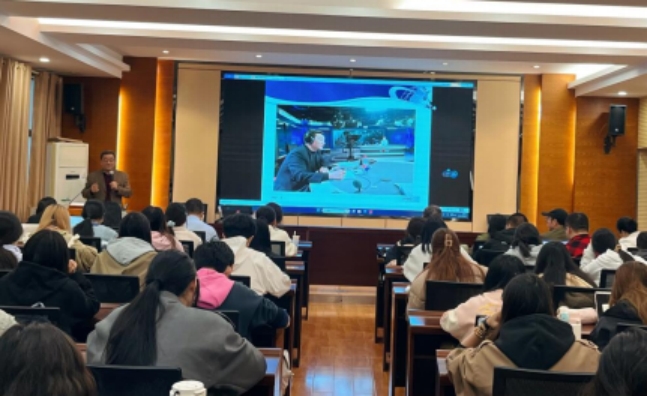
During the session held on July 24, themed “Research on Advanced Japanese Language Education from Multidimensional Perspectives: Interdisciplinary Theories and Methodological Innovation”, Guo presented a report entitled “New Approaches to Traditional Japanese Linguistic Studies in a Changing Context.” She provided a comprehensive analysis of the challenges faced by traditional linguistic research under conditions of globalization, digitalization, and interdisciplinarity.
Drawing on case studies, she introduced several lines of exploration: (1) theoretical innovation through a typological perspective in contrastive linguistics, including comparisons with Chinese, Korean, and English; (2) interdisciplinary integration incorporating insights from cognitive linguistics, sociolinguistics, and formal semantics; and (3) methodological innovation through the application of natural language processing (NLP) for large-scale digital text analysis, examining the laws of language evolution from both diachronic and synchronic dimensions. Her presentation sparked lively discussions and received an enthusiastic response from participants, particularly inspiring early-career researchers.
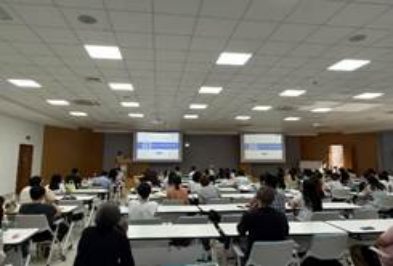
Guo Rongfei speaks at the Research and Innovation Salon
At the Competition Themed Session held on July 25, Fang Yinglin, coach of the Gold Award (First Runner-up) in the Japanese Track of the 2024 “Understanding Contemporary China” National Foreign Language Contest for College Students, delivered a presentation entitled Integrating “Competition with Teaching and Reflecting Deeply and Acting Promptly: Coaching Experience from the ‘ETIC Cup Understanding Contemporary China’ Multilingual Japanese Track.”
Based on her experience as a coach in two consecutive competitions, she analyzed the design features of tasks in both the Provincial Round and the National Final. Drawing on nearly a decade of experience in guiding Japanese majors at Central South University in high-level speech and debate competitions, and reflecting on the process of intensive coaching, she examined effective approaches to boosting learning and improving teaching via competitions. She also discussed methods for guiding students to deepen their understanding of the discourse system with Chinese characteristics. Her presentation demonstrated the diligence, perseverance, and positive spirit of our students and won high praise and recognition from participants.
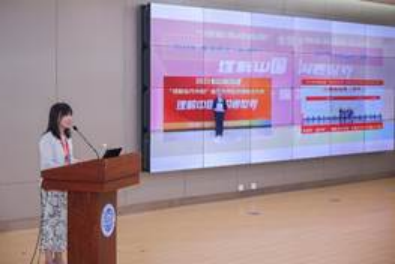
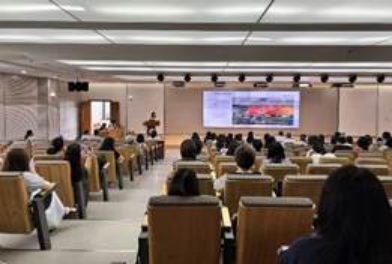
Fang Yinglin speaks at the Competition Themed Session
In recent years, young and middle-aged faculty members in the Department of Japanese at the School have achieved outstanding results in research, teaching, and competition coaching. By promoting teaching through research and integrating competition with teaching, the Department continues to explore new models for talent cultivation and enhance the distinctive features of its academic programs. Looking ahead, faculty members will continue to forge ahead with determination and contribute to the sustained development of the discipline.









 Dean's Email
 Alumni Home

 中文
中文
 Navigation
 Navigation


